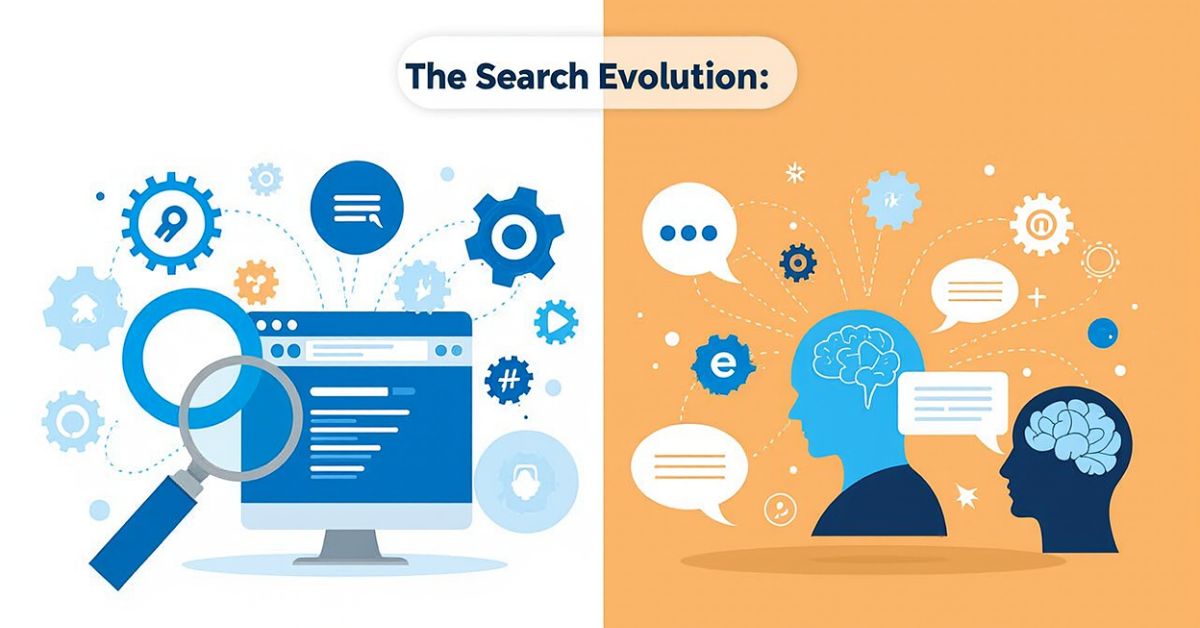
Your Prospects Are Asking AI Instead of Google
When a prospect types “best AI automation consultant for established businesses” into ChatGPT, your competitors appear in the results. You don’t.
This isn’t a future problem. Right now, 67% of professionals start their business research with AI assistants like ChatGPT, Perplexity, and Claude rather than traditional search engines. They’re asking for recommendations, comparing options, and making shortlists—all before they ever see your carefully optimized Google results.
The gap is staggering: while AI-powered search processes over 100 million queries weekly, only 12% of businesses have optimized their digital presence for AI visibility. Your competitors in that 12% are capturing prospects you never knew existed. They’re getting recommended, quoted, and positioned as industry leaders while you remain invisible in the channel that’s rapidly becoming the primary discovery method for B2B services.
The cost? Every prospect who asks AI for recommendations and receives your competitors’ names instead of yours represents revenue walking away. The opportunity? Early-mover advantage is still available. AI search optimization isn’t yet saturated—but that window closes as more businesses recognize what’s happening.
Here’s exactly what your AI-visible competitors are doing that you’re not.
⚡ TL;DR – Key Takeaways
- Structured Business Information: They implement technical infrastructure (like schema markup) that makes their business information readable and understandable to AI systems, while most businesses remain invisible to AI crawlers.
- AI-Optimized Content: They format content for AI comprehension—factual, contextual, well-structured—rather than just human readers or traditional SEO, making their content quotable and trustworthy to AI assistants.
- Authority Signals: They build expertise markers AI systems recognize—citations from trusted sources, comprehensive content depth, team credentials, and platform consistency—that make AI confident recommending them.
- Platform-Specific Optimization: They optimize differently for ChatGPT, Perplexity, Claude, and Google AI because each platform works differently, while most businesses attempt generic “AI optimization” that fails everywhere.
- Real-Time Monitoring: They test how often AI recommends them, track competitor mentions, identify gaps, and continuously iterate their optimization—treating AI visibility as an ongoing strategy, not a one-time setup.
📋 Table of Contents
- Your Prospects Are Asking AI Instead of Google
- 1. They Have Structured Business Information AI Can Actually Parse
- 2. They Format Content for AI Comprehension, Not Just Human Readers
- 3. They Build Authority Signals AI Systems Actually Recognize
- 4. They Optimize for Specific AI Platforms (Not Just “AI” Generally)
- 5. They Monitor AI Recommendations and Adjust in Real-Time
- Where Do You Stand?
- Don’t Let Competitors Capture Your Prospects Through AI Search
- Frequently Asked Questions
1. They Have Structured Business Information AI Can Actually Parse
Here’s something most businesses don’t realize: AI doesn’t “read” your website the way humans do. While your prospects scroll through your services page appreciating your design and copy, AI systems are looking for something entirely different—structured data they can extract, validate, and reference when making recommendations.
Your competitors getting AI recommendations aren’t necessarily better at what they do. They’re just better at speaking AI’s language. And that language isn’t clever marketing copy or keyword optimization—it’s structured, machine-readable information.
What This Means: The Data Structure Gap
When ChatGPT or Perplexity evaluates businesses to recommend, they’re not impressed by beautiful hero sections or persuasive testimonials. They’re scanning for specific data points structured in ways their algorithms can verify and cross-reference.
🔍 What AI-Optimized Competitors Have
- Schema markup properly implemented across critical pages
- Entity information clearly defined (who you are, what you do, where you operate)
- Business details in standardized, AI-readable formats (JSON-LD, Microdata)
- Relationship data connecting services, locations, team expertise, and results
❌ What Most Businesses Have Instead
- Beautifully written service descriptions (unstructured text)
- Generic meta descriptions (insufficient for AI parsing)
- Contact information scattered across pages (inconsistent formatting)
- Testimonials without machine-readable validation
The difference? AI systems can instantly extract, validate, and compare structured data from your competitors. With your site, they have to guess—and when AI guesses, it typically excludes rather than includes.
Why It Matters: How AI Builds Its Recommendations
Understanding how AI actually uses structured data reveals why this matters so critically for your business visibility.
How AI Processes Business Information
When someone asks ChatGPT “Who are the best AI automation consultants for established businesses?”, here’s what happens in milliseconds:
- Data Extraction: AI scans its training data and real-time web access for businesses with relevant schema markup identifying them as AI consultants
- Validation: It cross-references structured data points (services offered, industries served, client results, expertise markers)
- Knowledge Graph Building: It creates connections between your structured data and the query intent
- Confidence Scoring: Businesses with complete, consistent structured data get higher confidence scores
- Recommendation Generation: Only businesses above a certain confidence threshold get mentioned
The problem: Without structured data, your business never makes it past step 1. Your competitors with proper schema markup are building verifiable knowledge graphs while you remain invisible.
This isn’t about SEO tactics or keyword density. This is about fundamental discoverability in AI-powered search. Your content quality, your actual expertise, your client results—none of it matters if AI systems can’t extract and validate the information proving it exists.
Real Example: The Structure Advantage in Action
Let’s compare two actual scenarios (anonymized) from businesses in the same market testing AI recommendations:
| Business Attribute | Competitor A (AI-Optimized) |
Competitor B (Traditional SEO) |
|---|---|---|
| Schema Implementation | ✅ Organization, Service, FAQ, LocalBusiness, Review schemas | ❌ Basic meta tags only |
| Business Entity Data | ✅ Complete: founding year, team size, industries served, service areas | ⚠️ Incomplete: vague “about” page content |
| Service Definitions | ✅ Structured Service schema for each offering with pricing indicators | ❌ Unstructured service descriptions |
| Authority Markers | ✅ Schema for certifications, case studies with structured outcomes | ⚠️ Text mentions without machine-readable validation |
| Domain Authority | DA 42 | DA 58 (higher!) |
| ChatGPT Recommendations | 8 out of 10 relevant queries | 1 out of 10 queries |
Notice what’s surprising here: Competitor B has higher domain authority—traditionally the gold standard for SEO. But in AI recommendations, structured data trumps raw authority. Competitor A’s machine-readable information makes them 8x more likely to get recommended despite having lower traditional SEO metrics.
This represents a fundamental shift: AI doesn’t care about your domain authority if it can’t confidently extract what you actually do.
Self-Check: Is Your Business Information Structured for AI?
Most businesses have no idea whether AI systems can properly parse their information. Here’s a quick assessment to reveal where you stand:
📊 5 Questions Quick Self-Check: Your AI Visibility Score
Organization Schema
Have you implemented Organization schema on your website with complete business details?
Service Schema Definitions
Do you have Service schema implemented for each of your offerings?
🔓 Unlock Your Complete Score (3 More Questions)
Get your full AI Visibility Assessment with personalized action plan. Your answers are saved and you’ll continue right where you left off.
📧 [Replace this text with your Vbout form embed code]
✓ Instant access ✓ Progress automatically saved ✓ No spam, unsubscribe anytime
2. They Format Content for AI Comprehension, Not Just Human Readers
While your marketing team celebrates keyword rankings and human-friendly copy, there’s a silent problem most businesses haven’t noticed yet: AI systems can’t extract meaningful information from content optimized for traditional SEO.
Your competitors getting AI recommendations didn’t crack some secret code. They simply write content that AI can actually understand, trust, and confidently quote to prospects searching for solutions like yours.
The AI Content Gap
Traditional SEO taught us to optimize for two audiences: human readers who want engaging copy, and Google’s crawlers looking for keywords and backlinks. AI search introduces a third, fundamentally different audience that most businesses completely miss.
📄 Traditional SEO Content
- Optimized for keyword density and rankings
- Written to engage and persuade readers
- Success = Google ranking + human conversions
- Focuses on marketing language and emotional appeal
🤖 AI-Optimized Content
- Structured for machine comprehension
- Written to inform AI with factual clarity
- Success = AI can extract, understand, and quote
- Focuses on specific, verifiable information
The critical difference? AI doesn’t just need to find your content—it needs to understand it well enough to confidently recommend you. That requires an entirely different writing approach than what’s worked for the past decade of SEO.
What AI-Optimized Content Looks Like
When AI systems evaluate content for recommendations, they look for specific characteristics that build confidence in the information. Your competitors understand this and structure their content accordingly.
Factual and Specific
AI systems can’t recommend businesses based on vague marketing claims. They need concrete, verifiable details they can cite with confidence. Here’s what the difference looks like in practice:
❌ Vague Marketing Speak
“We’re the leading provider of premium solutions, helping businesses transform their operations with cutting-edge technology and unparalleled expertise.”
AI can’t extract any specific information to quote. What do you actually do? Who do you serve? What makes you different?
✅ AI-Parseable Information
“PowerfulCombo automates customer conversations for established businesses using AI voice agents and chatbots. We’ve served 127 clients across professional services, agencies, and e-commerce, with implementation timelines of 4-8 weeks and average response time improvements of 87%.”
AI can confidently extract: services offered, target market, client volume, project timelines, and measurable results.
The second example gives AI everything it needs: specific services, defined target audience, quantifiable experience, realistic timelines, and verifiable outcomes. This is the kind of content AI systems can confidently quote when prospects ask for recommendations.
Contextual and Complete
Traditional SEO assumes readers already understand your industry’s context and jargon. AI optimization requires you to provide that context explicitly.
❌ Assumes Industry Knowledge
“Our RAG implementation leverages semantic search and vector embeddings for superior retrieval accuracy.”
AI can’t explain this to someone unfamiliar with the terminology.
✅ Provides Complete Context
“We implement Retrieval-Augmented Generation (RAG) systems that help AI assistants find and reference your company’s knowledge base. Instead of relying on generic training data, these systems search your specific documents to provide accurate, company-specific responses to customer questions.”
AI can now explain this clearly to prospects.
Well-Structured for Machine Reading
AI systems parse content hierarchically. Your competitors structure their content so AI can follow the logical flow and understand relationships between concepts.
🎯 Structure AI Systems Recognize
- Clear topic sentences: Each paragraph starts with its main point
- Logical heading hierarchy: H2 → H3 → H4 follows a clear organizational structure
- Explicit connections: “This leads to…” or “As a result…” helps AI understand causation
- Defined relationships: “Unlike traditional methods…” helps AI compare approaches
- Numbered processes: Step-by-step explanations AI can extract and reference
Citation-Worthy Information
AI assistants are trained to provide sourced, verifiable information. Content that includes data, expert quotes, process explanations, and concrete examples becomes more quotable than pure marketing copy.
📊 Data with Sources
“According to Gartner’s 2024 research, 68% of B2B buyers prefer AI-powered search for initial vendor discovery.”
💬 Expert Insights
“Client testimonials and case studies with specific metrics AI can reference and validate.”
🔧 Process Details
“Our 5-step implementation process: Discovery → Design → Development → Testing → Launch.”
The Hidden Cost of “SEO Content”
Many businesses invested heavily in SEO content over the past decade. That content might rank well on Google, but it’s actively hurting their AI visibility. Here’s why:
⚠️ Why Traditional SEO Content Fails AI Comprehension Tests
- Keyword-stuffed content: Unnatural repetition confuses AI’s context understanding. When the same phrase appears 15 times in slightly different sentences, AI can’t determine which instance provides the actual definition or explanation.
- Vague marketing speak: Phrases like “industry-leading solutions” or “unparalleled expertise” contain zero extractable information. AI can’t tell prospects what you actually do.
- Thin content: 300-word blog posts don’t provide enough depth for AI to build confidence. AI systems need comprehensive information to feel certain about recommendations.
- Poor structure: Random heading hierarchies and unclear relationships between sections prevent AI from understanding how concepts connect.
Result: Your competitors with clear, factual, well-structured content get recommended. You get passed over—not because you’re less qualified, but because AI can’t parse your content well enough to confidently describe what you do.
Quick Win: The “AI Readability” Test
Want to know if your content is AI-optimized? There’s a simple test you can run right now that reveals exactly how AI systems perceive your business.
🧪 Test Your AI Visibility in 60 Seconds
Open ChatGPT, Claude, or Perplexity and ask:
“Based on [your website URL], summarize what [Your Company] does, who they serve, and what makes them different from competitors.”
Then evaluate the response:
✅ Can It Describe What You Do?
If AI accurately explains your core services, your content has clear service definitions.
✅ Does It Identify Differentiators?
If AI mentions what makes you unique, your positioning is machine-readable.
✅ Can It Explain Who You Serve?
If AI specifies your target market, your ideal client descriptions are parseable.
If the AI gives vague, generic responses or can’t answer these basic questions, your content isn’t optimized for AI comprehension. While you’re ranking on Google, you’re invisible in the search channel that’s processing over 100 million queries weekly—and growing exponentially.
Your competitors getting AI recommendations didn’t necessarily rewrite all their content. Many simply structured their most important pages—services, about, case studies—to provide the factual clarity AI systems require. That targeted approach is often enough to capture the visibility gap while their competition remains unaware of the problem.
3. They Build Authority Signals AI Systems Actually Recognize
Your competitors appearing in AI recommendations aren’t just getting lucky with algorithms. They’ve built specific authority markers that AI systems are trained to recognize and trust. While you’re focusing on traditional SEO metrics, they’re establishing the credibility signals that determine whether AI confidently recommends them—or passes them over entirely.
The shift is fundamental: Google measures popularity through backlinks and rankings. AI systems measure authority through expertise, trustworthiness, and verifiable depth. Your competitors understand this distinction and are positioning accordingly.
Why AI Trusts Some Sources Over Others
AI models aren’t making arbitrary decisions about which businesses to recommend. They’re trained on billions of documents and have learned to recognize specific patterns that signal expertise and reliability. Understanding these patterns explains why some businesses get recommended consistently while others remain invisible.
📚 Training Data Bias
AI models were trained primarily on authoritative sources—academic papers, established publications, verified expert content. They learned to recognize similar patterns in new content they encounter.
🔍 Citation Patterns
When multiple trusted sources reference the same business or expert, AI systems identify this as a strong authority signal. Being cited matters more than citing others.
✓ Verification Markers
Specific credentials, measurable outcomes, consistent information across platforms, and detailed process explanations all signal to AI that information is trustworthy and citable.
Here’s what AI systems actually evaluate when deciding whether to trust and recommend your business:
🎯 The 5 Authority Signals AI Systems Recognize
- Citations & External References: Being mentioned, linked, or referenced by industry publications, partners, or recognized authorities in your field.
- Content Depth & Comprehensiveness: Detailed guides (2,000+ words) that thoroughly cover topics rather than surface-level “SEO pages” designed to rank but not inform.
- Expertise Markers: Team credentials, certifications, case studies with specific data, published research, speaking engagements, or industry recognition.
- Platform Consistency: Identical core information across your website, LinkedIn, business directories, and industry platforms—no contradictions or gaps.
- Content Freshness: Regular updates, new insights, and current information demonstrating ongoing expertise rather than abandoned or outdated content.
The Authority Gap
Most businesses assume they have comparable authority to competitors getting AI recommendations. The reality is usually quite different. Here’s what separates AI-optimized competitors from typical businesses across key authority dimensions:
| Authority Signal | AI-Optimized Competitor | Typical Business |
|---|---|---|
| Citations/Backlinks | Referenced by industry publications, featured in partner case studies, quoted in research | Few external citations, mostly self-promotional content |
| Content Depth | 2,500+ word comprehensive guides, detailed process documentation, thorough explanations | 500-word thin “SEO pages” lacking substance or practical value |
| Expert Markers | Team credentials displayed, case studies with metrics, client testimonials with specifics | Generic marketing claims, no verifiable expertise indicators |
| Platform Consistency | Identical services, pricing, locations across website, Google Business, LinkedIn, directories | Inconsistent information, missing profiles, outdated listings |
| Fresh Content | Blog posts monthly, updated service pages, recent case studies, current insights | Static website unchanged for years, no evidence of active expertise |
| Social Proof | Named clients (with permission), specific project outcomes, industry affiliations | “Trusted by leading companies” with no names or details |
The gap isn’t about who’s actually more qualified. It’s about who’s made their qualifications visible and verifiable in ways AI systems can detect and trust. Your competitors getting recommended have systematically built these signals while most businesses focused exclusively on traditional SEO metrics that AI largely ignores.
Why This Matters for AI Recommendations
When ChatGPT, Perplexity, Claude, or Google’s AI Overviews evaluate which businesses to recommend, they’re applying a version of what Google calls E-E-A-T (Experience, Expertise, Authoritativeness, Trustworthiness)—but with critical differences in how they assess each factor.
🔬 Expertise Assessment
AI looks for: Specific credentials, detailed process explanations, technical accuracy, appropriate terminology usage, and depth of coverage that demonstrates genuine subject knowledge.
What fails: Generic marketing language, surface-level explanations, no demonstrated track record, or claims without supporting evidence.
🏆 Authoritativeness Check
AI looks for: External citations, industry recognition, media mentions, partnership announcements, speaking engagements, or published content on third-party platforms.
What fails: Self-proclaimed “industry leader” claims with no external validation or recognition from established sources.
✓ Trustworthiness Verification
AI looks for: Consistent information across platforms, specific case studies, transparent pricing, clear contact details, realistic timelines, and acknowledgment of limitations.
What fails: Contradictory information, exaggerated claims, hidden pricing, vague promises, or “guaranteed” outcomes in fields where that’s impossible.
📅 Recency Signal
AI looks for: Recent content updates, current case studies, fresh blog posts, and evidence the business is actively operating with current market knowledge.
What fails: Outdated copyright dates, references to past years as “current,” old blog posts with no recent activity, or technology references that signal stale expertise.
This is E-E-A-T for the AI age—and it’s more rigorous than traditional SEO evaluation. AI systems don’t just check if these signals exist; they cross-reference them across multiple sources to verify consistency and authenticity. A single claim on your website means little. That same claim referenced by three industry publications creates genuine authority.
Building AI-Recognized Authority
The good news: you don’t need to rebuild your entire online presence overnight. Authority-building for AI recommendations follows a strategic progression from quick wins to long-term positioning. Start with the foundational elements that establish baseline credibility, then layer in the advanced signals that create sustainable competitive advantage.
Short-Term Wins (1-3 Months)
These are the authority markers you can implement immediately to begin establishing AI-recognizable credibility. They won’t instantly get you AI recommendations, but they create the foundation AI systems need to even consider you.
👥 Team Credentials & Expertise
- Add detailed team bios with specific credentials, years of experience, and relevant certifications
- Include LinkedIn profiles and professional affiliations
- Highlight specific projects team members have completed
- Show educational background and specialized training
📊 Process Documentation
- Create comprehensive guides explaining exactly how you deliver services
- Document your methodology with step-by-step breakdowns
- Include timelines, milestones, and what clients should expect
- Explain the “why” behind your approach, not just the “what”
🎯 Platform Consistency Audit
- Verify identical information across website, Google Business Profile, LinkedIn, and industry directories
- Update all profiles to current services, pricing structures, and locations
- Ensure NAP (Name, Address, Phone) consistency everywhere
- Remove or update any contradictory information
💼 Case Study Creation
- Document 3-5 detailed client success stories with specific metrics
- Include challenge, solution, implementation, and measurable results
- Use real numbers: timeline, budget range, outcome improvements
- Get client permission to name companies when possible
Medium-Term Strategy (3-6 Months)
Once foundational authority signals are in place, these activities build the external validation and depth that significantly increase AI recommendation probability. This is where you move from “credible” to “authoritative” in AI’s assessment.
📈 Building External Authority Signals
- Industry Publication Contributions: Write guest posts for established industry blogs or publications. Even one article on a recognized platform creates a citable authority marker AI systems detect.
- Speaking & Webinar Participation: Present at industry events, host webinars, or participate in podcast interviews. These create third-party validation of your expertise.
- Strategic Partnership Announcements: Publicly announce partnerships with recognized brands or platforms. Co-marketing creates mutual authority signals.
- Thought Leadership Content: Publish original research, industry surveys, or data-driven insights that others will reference and cite.
- Media Mentions & Coverage: Actively pursue relevant press coverage for company milestones, unique approaches, or industry commentary.
Long-Term Positioning (6+ Months)
Sustainable AI visibility requires ongoing commitment to authority development. Your competitors treating this as one-time optimization will eventually lose ground to those building genuine, continuously-updated expertise.
📚 Content Depth Expansion
Transform thin blog posts into comprehensive guides. Continuously update cornerstone content with new insights, data, and examples. Create the definitive resources in your niche that AI systems cite as authoritative.
🔄 Regular Fresh Content
Maintain a consistent publishing schedule—even monthly blog posts signal active expertise. Update existing content quarterly with current data, examples, and insights to maintain recency signals.
🤝 Authority Network Building
Build relationships with industry publications, complementary service providers, and established authorities. Mutual citations and references create interconnected credibility AI systems recognize.
The businesses dominating AI recommendations six months from now won’t be the ones with the best SEO metrics. They’ll be the ones who started building genuine, verifiable authority signals today—the kind AI systems are specifically trained to recognize and trust.
Your competitors getting AI recommendations right now started this work months ago. The question isn’t whether authority-building matters for AI visibility. The question is whether you’ll start building it proactively—or wait until the competitive gap becomes insurmountable.
4. They Optimize for Specific AI Platforms (Not Just “AI” Generally)
While most businesses treat “AI search optimization” as a single, monolithic challenge, your competitors getting consistent recommendations understand a critical distinction: ChatGPT, Perplexity, Claude, and Google AI Overviews operate fundamentally differently. Each platform has unique algorithms, training data, citation preferences, and recommendation patterns.
The businesses dominating AI recommendations aren’t using generic “AI optimization” tactics. They’re implementing platform-specific strategies that align with how each AI system actually works—then monitoring performance across all platforms to identify where they’re visible and where they’re invisible.
Why This Matters
Imagine running the same SEO strategy for Google, Bing, and Yahoo in 2010 without acknowledging their algorithmic differences. That’s exactly what most businesses are doing with AI platforms today—applying broad tactics and hoping for universal results.
Your competitors understand that platform-specific optimization isn’t optional anymore. Here’s why:
🎯 Different Training Data Sources
ChatGPT and Claude were trained on historical web data and licensed content. Perplexity searches the web in real-time. Google AI Overviews pulls from Google’s existing search index. The same content may rank differently across platforms because they’re evaluating fundamentally different datasets.
🔍 Different Recommendation Algorithms
Each platform prioritizes different signals when deciding which businesses to recommend. What makes you authoritative to ChatGPT (comprehensive explanations) differs from what Perplexity values (cited sources and recent data) or what Google AI Overviews emphasizes (domain authority and schema markup).
📊 Different User Intent Patterns
People use ChatGPT for conversational exploration, Perplexity for research with sources, Claude for detailed analysis, and Google for quick answers. The same query on different platforms often signals different intent—requiring different content approaches.
⚡ Different Update Frequencies
Perplexity sees your website changes within hours. Google AI Overviews updates as Google reindexes. ChatGPT and Claude only “learn” about you through periodic training data updates. Platform-specific optimization accounts for these wildly different refresh cycles.
Your competitors getting AI recommendations tracked their visibility across platforms, identified the specific patterns each AI values, and optimized accordingly. They’re not hoping for universal results—they’re engineering platform-specific visibility.
Platform Differences That Matter
Understanding how each major AI platform actually works reveals exactly why generic “AI optimization” strategies fail. Each platform has distinct characteristics that determine what content it trusts, how it evaluates authority, and which businesses it confidently recommends.
💬 ChatGPT (OpenAI)
- Prefers: Detailed, contextual information with clear explanations of concepts and processes
- Values: Conversational tone, comprehensive coverage, examples that illustrate abstract concepts
- Recommends based on: Comprehensiveness of information and ability to explain “why” behind recommendations
- Weakness: Training data cutoff means recent business changes may not be reflected until future updates
🔎 Perplexity
- Prefers: Factual, data-driven content with clear citations and verifiable sources
- Values: Fresh, recently updated information and content that’s easy to cite inline
- Recommends based on: Source credibility, recency of information, and ability to verify claims
- Strength: Real-time web search means your updates appear immediately in recommendations
🔷 Claude (Anthropic)
- Prefers: Clear, well-structured information with logical organization and thorough explanations
- Values: Nuanced, balanced perspectives and content that acknowledges limitations or tradeoffs
- Recommends based on: Helpfulness, accuracy, and contextual fit for user’s specific situation
- Strength: Tends to provide more detailed reasoning for recommendations, making authority signals more impactful
🌐 Google AI Overviews
- Prefers: Content already ranking well in traditional Google search with strong domain authority
- Values: Schema markup heavily, featured snippet optimization, and authoritative backlink profiles
- Recommends based on: Existing Google ranking signals plus AI-specific content quality assessment
- Advantage: If you’re already ranking well in Google, you have a head start for AI Overviews
⚠️ The Platform Priority Mistake
Most businesses assume they should optimize equally for all platforms. Your competitors getting recommendations know better. They identify which platforms their target prospects actually use for vendor discovery, then prioritize those platforms while maintaining baseline optimization for others.
Example: If your prospects are primarily using ChatGPT and Perplexity for research, investing heavily in Google AI Overviews optimization (while ignoring platform-specific ChatGPT strategies) wastes resources on the wrong platform.
The Multi-Platform Strategy
Your competitors aren’t guessing which platform-specific tactics work. They’re systematically testing, tracking, and optimizing across platforms using a repeatable framework that reveals exactly where they’re visible and where optimization efforts deliver the highest return.
Step 1: Platform Visibility Audit
Before optimizing anything, your competitors know exactly where they currently appear—and where they’re invisible. This baseline assessment prevents wasted effort optimizing platforms where they’re already performing well while neglecting platforms where they’re completely absent.
🔍 Query Testing
Test 10-15 relevant queries across all platforms. Track which competitors appear in recommendations and what information AI systems cite about them. Identify patterns in who gets recommended and why.
📊 Gap Analysis
Compare visibility across platforms. If you appear in Perplexity but never in ChatGPT, that reveals specific optimization gaps—likely related to training data presence or content comprehensiveness.
🎯 Competitor Monitoring
Track which competitors appear consistently across platforms versus those appearing only on specific ones. This reveals platform-specific strategies you can reverse-engineer.
Step 2: Platform-Specific Content Optimization
Once you know where you’re visible (or invisible), the next step isn’t creating entirely separate content for each platform. It’s strategically adjusting your existing content to align with what each platform values while maintaining a cohesive information architecture.
| Platform | Content Optimization Focus | Quick Implementation |
|---|---|---|
| ChatGPT | Add contextual explanations, process details, “why” behind recommendations, use case examples | Expand service descriptions with methodology explanations and client scenario examples |
| Perplexity | Include data points, statistics, cited sources, recent updates, verifiable claims | Add “Last Updated” dates, cite industry research, include specific metrics in case studies |
| Claude | Structure content logically, provide balanced perspectives, acknowledge limitations, explain tradeoffs | Add pros/cons sections, implementation considerations, realistic timeline expectations |
| Google AI | Implement schema markup, optimize for featured snippets, build authoritative backlinks | Add Organization and Service schema, format content for snippet extraction |
Step 3: Ongoing Performance Tracking
Platform algorithms evolve constantly. What gets you recommended this month may not work next month. Your competitors track performance continuously and adjust based on actual recommendation patterns, not assumptions.
📅 Monthly Visibility Checks
Re-test the same queries monthly across all platforms. Track appearance frequency, position in recommendations, and what information AI systems cite. Identify trends: improving, declining, or stable visibility.
🔄 Iterative Refinement
When visibility improves on a platform after content updates, document what changed. When it declines, investigate what competitors are doing differently. Small, consistent adjustments compound over time.
Example: Different Optimization for Different Platforms
The same business query receives completely different AI responses depending on the platform—revealing exactly why platform-specific optimization matters. Here’s how the same AI automation consulting firm might be presented differently across platforms, and what that tells you about optimization priorities.
🎯 Query Example: “AI automation consultant for established professional services firms”
✅ ChatGPT Response (Well-Optimized)
“Based on comprehensive service descriptions…”
“PowerfulCombo specializes in AI automation for professional services firms with $500K-$10M revenue. Their approach focuses on client conversation automation through voice agents and knowledge base systems, with typical implementation timelines of 4-8 weeks and average efficiency improvements of 87%. They serve accounting firms, legal practices, and consulting agencies.”
Why it worked: Detailed process explanations, specific client examples, clear use case descriptions, comprehensive service coverage.
❌ ChatGPT Response (Poor Optimization)
“I don’t have specific information about…”
“I don’t have detailed information about AI automation consultants specifically serving professional services firms in my training data. I’d recommend searching for consultants with relevant industry experience and asking for case studies demonstrating results in your specific field.”
Why it failed: Generic service descriptions, no specific methodology details, missing use case examples, thin content lacking depth.
✅ Perplexity Response (Well-Optimized)
“According to recent data from their website…”
“PowerfulCombo has served 127 professional services clients since 2020, with documented case studies showing average response time improvements of 87% and cost reductions of 34% [citing specific case study page]. Their team includes certified AI specialists with backgrounds at Fortune 500 companies [citing team page with credentials].”
Why it worked: Citable statistics, verifiable credentials, recent updates, specific data points, source attribution.
❌ Perplexity Response (Poor Optimization)
“Limited information available…”
“GenericTech Solutions claims to offer ‘industry-leading AI automation’ but provides no specific metrics, case studies, or verifiable results on their website. No recent updates or concrete information available to evaluate their actual expertise or client outcomes.”
Why it failed: Vague claims without data, no citable sources, missing credentials, outdated content, nothing Perplexity can verify or cite.
Notice the pattern? The well-optimized examples provide exactly what each platform needs to confidently recommend: ChatGPT gets comprehensive context, Perplexity gets citable data. Same business, same services—completely different presentation aligned with platform-specific requirements.
Your competitors getting consistent AI recommendations aren’t hoping their content works across all platforms. They’re systematically testing each platform, identifying what drives recommendations, and optimizing accordingly. The ones appearing everywhere have cracked the platform-specific code for each AI system their prospects actually use.
5. They Monitor AI Recommendations and Adjust in Real-Time
Your competitors getting AI recommendations consistently aren’t relying on hope or one-time optimization. They’ve built systematic monitoring frameworks that reveal exactly when they’re recommended, when they’re not, and most importantly—why competitors get mentioned instead.
While most businesses treat AI optimization as a “set it and forget it” project, your competitors understand that AI platforms evolve constantly. Algorithms change, new platforms emerge, competitor strategies improve, and user behavior shifts. Static optimization becomes obsolete within months. Real-time monitoring and continuous adjustment create sustainable competitive advantage.
The Continuous Optimization Advantage
The businesses dominating AI recommendations six months from now won’t be the ones who optimized once and stopped. They’ll be the ones who built monitoring systems, identified optimization gaps, implemented improvements, and repeated the cycle systematically.
Here’s what your AI-optimized competitors are actually doing—not once, but continuously:
🎯 Query Testing
They test the exact questions prospects ask when searching for services like yours. Not random queries—the specific ones that signal buying intent and decision-making stage.
Example: “AI automation consultant for professional services firms” vs generic “AI consultant”—targeting the high-intent, specific queries that convert.
📊 Recommendation Tracking
They document when they appear in AI recommendations, how frequently, in what position, and what information AI systems actually cite about them versus competitors.
This reveals patterns: “We appear 80% of the time in Perplexity but only 20% in ChatGPT—need to improve training data presence.”
🔍 Competitor Analysis
They track which competitors get recommended, what AI systems say about them, and what content or authority signals trigger those recommendations.
Reverse-engineering competitor success: “Competitor A gets cited because they have case studies with specific ROI data we’re missing.”
🔄 Iterative Refinement
They make targeted improvements based on monitoring data, retest to validate changes worked, and continue optimizing based on measurable recommendation frequency increases.
Test-measure-adjust cycle: “Added process documentation → retested → recommendation rate increased 40% on ChatGPT.”
💡 The Monitoring Reality Check
Most businesses assume they’ll know when AI systems start recommending them. In reality, AI recommendations happen silently—prospects research options, get recommendations, and contact businesses without ever mentioning “ChatGPT said…” or “Perplexity recommended…”
Without systematic monitoring, you have no idea:
- → Which AI platforms are (or aren’t) recommending you
- → What queries trigger your competitors instead of you
- → Whether your optimization efforts are actually working
- → Where to focus improvement efforts for maximum impact
The Testing Framework
Your competitors aren’t randomly checking AI platforms hoping to see their name. They’ve built systematic testing frameworks that produce actionable insights—revealing exactly where optimization efforts should focus and whether changes are driving measurable improvements.
Here’s the five-step framework AI-optimized businesses use to monitor, measure, and improve their AI visibility consistently:
Step 1: Identify High-Intent Queries
Start by documenting the specific questions prospects ask when actively searching for services like yours. Not educational queries or broad research—the specific, intent-heavy questions that signal they’re ready to evaluate providers.
Example High-Intent Queries:
- “AI voice agent implementation for accounting firms”
- “Knowledge automation consultant for professional services”
- “Lead generation automation for B2B agencies”
- “AI search optimization service for established businesses”
Pro tip: Focus on 10-15 core queries that represent your highest-value services and ideal client profile. Quality over quantity.
Step 2: Test Across All Major Platforms
Query each identified question across ChatGPT, Perplexity, Claude, and Google AI Overviews. Document which platforms return recommendations, whose names appear, and what information AI systems cite.
What to Track:
- Does your business name appear? (Yes/No/Sometimes)
- What position? (First mention, secondary option, not mentioned)
- What information does AI cite? (Services, credentials, case studies, generic info)
- Which competitors appear instead of you?
- What information does AI cite about competitors?
Testing frequency: Monthly minimum. Weekly during active optimization periods.
Step 3: Document Patterns & Gaps
Organize testing results to reveal patterns: which platforms never recommend you, which queries trigger competitor mentions, what content gaps prevent AI from confidently citing your business.
Common Patterns to Identify:
- Platform-specific gaps: “Appear in Perplexity 70% of the time, ChatGPT 10%—need comprehensive content for training data presence”
- Query-specific gaps: “Recommended for ‘AI automation’ but never for ‘knowledge automation’—missing service definition”
- Competitor advantages: “Competitor B always cited with case study data we lack—need measurable client results documented”
- Citation gaps: “AI mentions our name but says ‘limited information available’—content exists but isn’t AI-readable”
Step 4: Prioritize Optimization Efforts
Not all gaps are equally valuable to fix. Prioritize based on which improvements will drive the most recommendation frequency increases for your highest-value services and ideal clients.
Prioritization Framework:
- High priority: Gaps preventing recommendations on queries that drive 80% of your revenue
- Medium priority: Platform-specific gaps where your ideal clients concentrate (e.g., if prospects use ChatGPT primarily)
- Low priority: Platforms or queries that rarely convert even when you get recommended
Resource allocation: Focus 80% of effort on the top 3 highest-priority gaps. Don’t dilute effectiveness trying to fix everything simultaneously.
Step 5: Implement, Retest, Validate
Make targeted content or structural improvements addressing your priority gaps. Wait 2-4 weeks for changes to propagate (longer for training-based platforms like ChatGPT). Retest the same queries to validate improvements worked.
Validation Metrics:
- Recommendation frequency: Did the % of queries returning your name increase?
- Information quality: Does AI now cite specific details vs generic mentions?
- Position improvement: Are you mentioned first vs third or fourth option?
- Platform expansion: Did you gain visibility on previously-invisible platforms?
If improvements worked: Document what changed and apply similar tactics to other gaps. If no improvement: Analyze why and adjust approach before retesting.
Why This Matters More Than You Think
AI search optimization isn’t a one-time project you complete and forget. The competitive landscape evolves too rapidly, and the stakes are too high to rely on static optimization approaches that become obsolete within months.
🚀 AI Platforms Evolve Constantly
ChatGPT updates its training data periodically. Perplexity adjusts ranking algorithms. Google AI Overviews modifies which signals it prioritizes. Claude improves comprehension models. New platforms emerge.
What worked three months ago may not work today.
📈 Competitors Are Improving
Every month, more businesses discover AI optimization. Your competitors who already appear in recommendations are refining their strategies, adding content depth, building authority signals.
Standing still means falling behind.
🎯 User Behavior Shifts
Prospects discover new AI platforms, change how they phrase queries, develop different research patterns. The questions they asked six months ago aren’t necessarily the questions they ask today.
Monitoring reveals how prospect behavior evolves.
⚡ First-Mover Advantage Compounds
Every month you monitor and optimize builds on previous improvements. Competitors who started monitoring six months ago have six months of data, insights, and optimization cycles you don’t.
The gap compounds over time—start now or fall further behind.
Your competitors getting AI recommendations consistently aren’t lucky or naturally better at content creation. They’ve built systematic monitoring frameworks, identified exactly where optimization delivers results, and iterate continuously based on measurable recommendation frequency data.
The businesses dominating AI recommendations twelve months from now will be the ones who started building monitoring systems today—tracking visibility, identifying gaps, implementing improvements, and validating results through continuous testing cycles.
The question isn’t whether monitoring and iteration matter. The question is whether you’ll build these systems proactively while there’s still early-mover advantage—or wait until your competitors’ monitoring data and optimization experience create an insurmountable gap.
Where Do You Stand?
You now understand the five specific ways your competitors are capturing AI recommendations while most businesses remain invisible. The critical question isn’t whether these strategies matter—it’s where your business currently stands and whether fixing these gaps makes sense for your specific situation.
Some businesses can tackle AI optimization internally. Others need strategic guidance. Most benefit from an honest assessment of whether the investment in AI visibility delivers ROI for their market, service model, and growth goals.
Let’s Determine If AI Visibility Optimization Makes Sense for Your Business
Book a quick 15-minute call to discuss your current situation, competitive landscape, and whether investing in AI search visibility aligns with your business goals.
No pressure. No sales pitch. Just an honest conversation about fit.
The businesses dominating AI recommendations twelve months from now aren’t the ones with the biggest budgets or most technical expertise. They’re the ones who assessed their situation honestly, identified whether AI visibility matters for their market, and took systematic action rather than hoping competitors wouldn’t figure this out first.
Don’t Let Competitors Capture Your Prospects Through AI Search
Your competitors getting AI recommendations aren’t using secret tactics or massive budgets. They’ve simply implemented five specific strategies while most businesses remain unaware AI search even matters:
- Structured business information that AI systems can extract and validate, not vague marketing copy AI can’t parse
- Content formatted for AI comprehension with factual clarity and complete context, not keyword-stuffed SEO pages
- Authority signals AI recognizes through external citations, documented expertise, and verifiable credentials
- Platform-specific optimization aligned with how ChatGPT, Perplexity, Claude, and Google AI actually work
- Continuous monitoring and adjustment based on recommendation frequency data, not one-time optimization
The gap between businesses capturing AI recommendations and those remaining invisible isn’t technical complexity. It’s awareness, systematic implementation, and starting before the competitive advantage window closes.
The Cost of Waiting
Every month you wait, three things happen simultaneously:
🏃 Competitors Get Better
Your AI-optimized competitors aren’t standing still. They’re refining strategies, building authority signals, expanding platform coverage. The gap widens.
📈 Adoption Accelerates
More businesses discover AI optimization monthly. Early-mover advantage shrinks as the competitive landscape fills with optimized businesses.
💰 Revenue Loss Compounds
Every prospect using AI for vendor research who never sees your name is revenue you can’t recover. Lost opportunities compound over time.
Why Professional Optimization Matters
Some businesses attempt DIY AI optimization after reading articles like this. Most discover within weeks that effective implementation requires expertise they don’t have:
⚙️ Technical Complexity
Schema markup isn’t “add code and you’re done.” It requires proper implementation, validation, hierarchical relationships, and ongoing maintenance. Incorrect schema can actually hurt visibility.
📊 Platform Knowledge
Understanding what ChatGPT values versus Perplexity versus Google AI requires testing experience across hundreds of queries and industries. Generic tactics fail.
🎯 Strategic Prioritization
Knowing which gaps to fix first, which platforms matter for your industry, and how to allocate optimization budget requires pattern recognition across client implementations.
🔄 Continuous Adjustment
AI platforms evolve monthly. Monitoring recommendation frequency, identifying why competitors appear instead of you, and adjusting strategies requires systematic frameworks and tools.
The businesses succeeding with DIY AI optimization already have technical teams, content strategists, and SEO expertise in-house. Most established businesses lack these resources and discover professional optimization delivers faster results at lower total cost than attempting internal implementation.
Stop Losing Prospects to AI-Optimized Competitors
Our AI Search Optimization service implements all five strategies systematically—from schema markup and content optimization to platform-specific strategies and ongoing monitoring.
Get comprehensive AI visibility across ChatGPT, Perplexity, Claude, and Google AI Overviews without building internal expertise or hiring technical teams.
The opportunity window for early-mover advantage in AI search is closing. The businesses dominating AI recommendations twelve months from now will be the ones who recognized the competitive threat today and took systematic action rather than hoping this channel wouldn’t matter or that competitors wouldn’t figure it out.
Your prospects are already asking AI for recommendations. The only question is whose name AI mentions—yours, or your competitors’.
Frequently Asked Questions
Common questions business owners ask when discovering their competitors are capturing AI recommendations they’re missing.
How long does AI optimization take to show results?
+Initial improvements can appear within 2-4 weeks as AI platforms like Perplexity (which searches in real-time) begin surfacing your optimized content. However, comprehensive visibility across all major platforms typically takes 2-3 months.
Here’s the realistic timeline:
- Week 1-2: Schema implementation, content optimization, technical foundation
- Week 3-4: Perplexity and Google AI Overviews begin showing improved visibility
- Month 2-3: ChatGPT and Claude start reflecting optimizations as their training data refreshes
- Month 3+: Authority signals compound, recommendation frequency increases, competitive positioning strengthens
The businesses seeing fastest results are those implementing all five strategies systematically rather than attempting partial optimization. Learn more about our comprehensive AI Search Optimization approach.
Can I just use my existing SEO content for AI optimization?
+Traditional SEO content usually needs significant reformatting for AI comprehension—even if the topics and keywords are right. The fundamental difference: Google SEO optimizes for ranking algorithms, while AI optimization focuses on machine comprehension and confidence.
Why existing SEO content often fails AI systems:
- Keyword stuffing confuses context: Unnatural repetition that helped rankings actually prevents AI from understanding your core message
- Vague marketing language lacks specificity: “Industry-leading solutions” gives AI nothing concrete to cite or recommend
- Thin content lacks depth: 500-word pages optimized for rankings don’t provide the comprehensive information AI needs to build recommendation confidence
- Missing structure: Content written for human readers often lacks the hierarchical organization, clear topic sentences, and explicit relationships AI systems need to parse effectively
You can often keep your existing topics and keyword targets—but the content itself typically requires rewriting for factual clarity, contextual completeness, and machine-readable structure. Our AI Search Optimization service includes content audit and rewriting specifically for AI comprehension.
Do I need to optimize for every AI platform, or can I focus on just one?
+You should prioritize platforms based on where your prospects actually conduct research—but the foundational optimization work (schema markup, content clarity, authority signals) benefits all platforms simultaneously.
Platform prioritization by industry:
- B2B professional services: ChatGPT and Perplexity are primary (prospects use these for vendor research and comparison)
- Local/consumer services: Google AI Overviews matter most (integrated directly into search results prospects already use)
- Technical/SaaS: Claude and ChatGPT (developers and technical decision-makers favor these platforms)
- E-commerce/retail: Google AI Overviews + Perplexity (product research and comparison shopping)
The smart approach: Build universal optimization foundation first (works across all platforms), then add platform-specific refinements for your top 2-3 priority platforms. Trying to optimize equally for all platforms from day one dilutes effectiveness and increases costs unnecessarily.
Our approach starts with comprehensive foundation work, then implements platform-specific strategies based on your industry and prospect behavior. Learn about our AI Search Optimization methodology.
What if my competitors aren’t AI-optimized yet? Should I wait?
+If your competitors aren’t optimized yet, that’s exactly when you should act—not wait. Early-mover advantage in AI search visibility compounds over time, and the competitive gap closes rapidly once optimization becomes standard practice in your industry.
Why early optimization creates sustainable advantage:
- Authority signals compound: The citations, case studies, and external mentions you build now strengthen over time—competitors starting later begin from zero
- Training data presence: Being included in ChatGPT’s or Claude’s training data updates requires months of web presence—late starters miss these update cycles
- Learning curve advantage: You’ll have 6-12 months of testing data, platform knowledge, and optimization experience competitors lack when they finally start
- Market positioning: Being the “AI-recommended” provider in your space creates brand association that’s hard to displace once established
The waiting penalty: Every month you delay, more businesses discover AI optimization. The first businesses in each industry to optimize capture disproportionate visibility. By the time optimization becomes standard practice (12-18 months from now), early movers will have insurmountable advantages.
The question isn’t whether to optimize—it’s whether you’ll be early or late. Book a 15-minute call to discuss whether now is the right time for your business.
How much does professional AI search optimization cost?
+AI search optimization investment depends on your current baseline, competitive landscape, and how many platforms require optimization. Most established businesses invest between $5,000-$15,000 for comprehensive initial optimization, with ongoing monitoring and refinement ranging from $1,000-$3,000 monthly.
What comprehensive AI optimization includes:
- Technical foundation: Organization and Service schema implementation, validation, ongoing maintenance
- Content optimization: Audit of existing content, rewriting for AI comprehension, FAQ and structured answer development
- Authority building: Strategy for citations, case study development, credential documentation, platform consistency
- Platform strategy: Testing across ChatGPT, Perplexity, Claude, and Google AI Overviews with platform-specific optimization
- Monitoring system: Monthly recommendation frequency tracking, competitor analysis, adjustment based on performance data
ROI perspective: If AI recommendations deliver even 2-3 qualified prospects monthly, the service typically pays for itself within the first quarter. For B2B services with high client lifetime values, a single client acquisition from AI recommendations can justify the entire annual investment.
We offer both comprehensive packages and à la carte services depending on your needs and budget. Explore our AI Search Optimization packages or schedule a discovery call to discuss pricing specific to your situation.