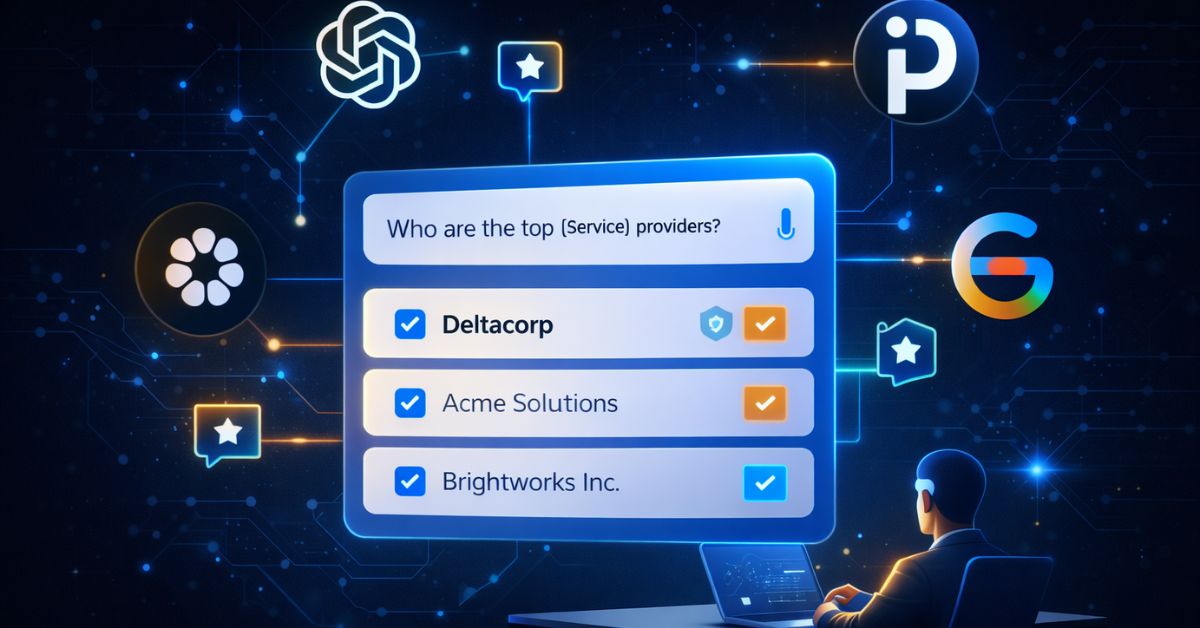
You mastered SEO, climbed Google rankings, and finally saw consistent organic traffic flowing to your business. Then overnight, everything changed. Your prospects stopped clicking through search results—they started asking AI assistants for recommendations instead. And suddenly, your competitors are getting recommended by ChatGPT, Claude, and Perplexity while your business isn’t even mentioned.
Welcome to the GEO vs SEO era—where traditional search engine optimization is no longer enough to capture the modern buyer’s attention. While you’ve been optimizing for Google’s algorithm, the game board itself has shifted. By 2026, industry analysts project that 85% of searches will be AI-powered, fundamentally changing how prospects discover businesses like yours.
The difference between generative engine optimization (GEO) and traditional SEO isn’t just technical—it’s existential for your business visibility. When someone asks ChatGPT “What CRM would you recommend for a 50-person sales team?” they’re not browsing ten blue links. They’re receiving one synthesized answer with specific recommendations. If your business isn’t optimized for AI search, you’re simply invisible to an entire generation of decision-makers.
But here’s the critical insight most business owners miss: GEO isn’t about replacing your SEO efforts—it’s about evolving them.. The fundamentals you’ve mastered still matter. The difference lies in understanding what changed, what stayed the same, and how to bridge the gap between traditional search optimization and AI-powered discovery.
In this comprehensive comparison, you’ll discover exactly how GEO differs from SEO, why both matter for your business visibility, and the practical steps to optimize for AI search without abandoning the SEO foundations that still drive results. Whether you’re a marketing director protecting your hard-won rankings or a business owner wondering if you need to start over, this guide will show you the path forward.
Let’s cut through the confusion and examine what really changed when AI took over search.
TL;DR – Key Takeaways
- GEO vs SEO isn’t either/or—it’s both: Traditional SEO still drives the majority of web traffic today, but GEO (generative engine optimization) captures the rapidly growing AI search market. By 2026, 85% of searches are projected to be AI-powered. You need both strategies working together.
- User behavior fundamentally changed: Traditional SEO targets people who search keywords and browse through results. GEO targets people who ask AI assistants conversational questions and receive direct recommendations. Same prospects, completely different discovery path.
- What changed with AI search: Success metrics shifted from rankings to recommendation frequency. Competition expanded from your industry peers to any authoritative source. Optimization targets multiplied from Google to ChatGPT, Claude, Perplexity, and other AI platforms.
- What stayed the same: Quality content, authoritative backlinks, technical foundations, and user experience still matter for both SEO and GEO. Your existing SEO expertise isn’t wasted—it’s the foundation for effective GEO implementation.
- Early adopter advantage is massive: Only 12% of businesses have started optimizing for AI search. Getting your business recommended by AI assistants now, while competition is low, positions you for the inevitable shift in user behavior.
- Practical implementation timeline: Basic GEO optimization takes 6-8 weeks with professional help. Results become measurable within 2-3 months as you track AI recommendation frequency. ROI typically positive within 6 months for established businesses.
- The real risk: AI recommendations create winner-take-most dynamics. When ChatGPT recommends 2-3 businesses for a query, being #4 means complete invisibility. Unlike traditional SEO where page 2 still gets some traffic, AI search delivers zero visibility for non-recommendations.
Table of Contents
- What is SEO? (The Foundation You Already Know)
- What is GEO (Generative Engine Optimization)?
- GEO vs SEO: The 7 Critical Differences
- What Hasn’t Changed: The SEO Fundamentals That Still Matter
- Do You Still Need SEO?
- How to Start Optimizing for Generative Engines (5 Practical Steps)
- The Future is Both/And, Not Either/Or
What is SEO? (The Foundation You Already Know)
Before we explore how AI changed the game, let’s establish the baseline. Search engine optimization (SEO) has been the cornerstone of digital visibility for over two decades, and understanding its mechanics helps you grasp exactly what shifted when generative engines entered the picture.
How Traditional Search Engines Work
Google and other traditional search engines follow a predictable four-step process. First, they crawl your website—automated bots systematically browse every page they can find. Second, they index that content, essentially filing it in a massive database organized by topic, keywords, and relevance signals. Third, when someone searches, the algorithm ranks indexed pages based on hundreds of factors. Finally, they display results as the familiar list of ten blue links.
The user journey was simple: search a keyword phrase, scan through results, click the most promising link, browse the website, repeat if needed. This click-through behavior shaped everything about how businesses optimized for visibility.
The Core Pillars of Traditional SEO
Every successful SEO strategy rests on three fundamental pillars that have remained remarkably consistent since Google’s early days:
| SEO Pillar | What It Includes | Why It Matters |
|---|---|---|
| On-Page SEO | Keywords in content, meta tags, title optimization, header structure, internal linking, content quality | Tells search engines what your pages are about and how they relate to each other |
| Off-Page SEO | Backlinks from other sites, domain authority, brand mentions, social signals, referral traffic | Signals trust and authority—if others link to you, you must be credible |
| Technical SEO | Site speed, mobile optimization, structured data, XML sitemaps, crawlability, security (HTTPS) | Ensures search engines can access, understand, and efficiently index your content |
These pillars didn’t exist in isolation. A high-authority backlink (off-page) pointing to a well-optimized page (on-page) that loads quickly (technical) created a compounding effect. Master all three, and you could dominate your niche for years.
Why SEO Dominated for 20+ Years
Traditional SEO worked because it aligned perfectly with how people discovered information online. Google became synonymous with internet search, processing over 8.5 billion queries daily by 2024. The rules were clear: create quality content, earn authoritative backlinks, maintain solid technical foundations, and you’d see predictable traffic growth.
The metrics were tangible and trackable. You could watch your rankings climb from page three to page one. You could measure exactly how much organic traffic each ranking position generated. You could calculate ROI by connecting rankings to conversions. This measurability made SEO the most cost-effective marketing channel for businesses of all sizes.
The SEO Success Formula (2000-2023)
Rank in top 3 positions → Drive consistent organic traffic → Convert visitors to customers → Reinvest in more content → Compound authority over time. This virtuous cycle created lasting competitive advantages and made SEO the foundation of digital marketing strategies worldwide.
But then AI assistants arrived, and while the fundamentals didn’t disappear, the playing field expanded dramatically. Let’s examine what that expansion means for your business visibility.
What is GEO (Generative Engine Optimization)?
While traditional search engines continue processing over 8.5 billion queries daily, a parallel revolution is unfolding. AI assistants like ChatGPT, Claude, Perplexity, and Google’s AI Mode are fundamentally changing how people discover businesses and make purchasing decisions. This shift requires a new optimization approach: generative engine optimization.
The Rise of AI Search Assistants
The numbers tell a compelling story. Gartner predicts traditional search engine volume will drop 25% by 2026 as users shift to generative AI assistants. ChatGPT alone processes millions of queries daily, while Perplexity, Claude, and other platforms capture increasingly significant portions of search behavior.
What makes this shift dramatic isn’t just the adoption rate—it’s the user behavior change. When someone asks ChatGPT “What CRM would you recommend for a 50-person sales team?” they’re not preparing to click through ten blue links. They’re expecting a direct, synthesized answer with specific recommendations. They receive that answer in seconds, often without ever visiting a traditional search engine.
This conversational search pattern feels more natural to users. Instead of thinking in keywords, they ask questions the way they’d ask a knowledgeable colleague. Instead of evaluating multiple sources themselves, they receive pre-synthesized information with citations. The cognitive load drops dramatically, making AI search increasingly attractive for complex queries.
How Generative Engines Work Differently
Traditional search engines crawl the web in real-time, index billions of pages, and rank them algorithmically based on relevance signals. Generative AI engines operate on fundamentally different mechanics that create both challenges and opportunities for business visibility.
Generative AI models combine two approaches: they draw on patterns learned during training AND can access real-time web data when needed. ChatGPT and Claude both offer web search features that allow them to retrieve current information, while Perplexity specializes in live web integration. However, even with web access, these AI assistants prioritize authoritative, well-structured sources when synthesizing recommendations. If your business information is scattered, outdated, or poorly formatted, you remain effectively invisible even when the AI can technically find you.
The synthesis process matters enormously for business visibility. When an AI assistant answers a business query, it doesn’t just retrieve information—it evaluates multiple sources, assesses credibility, identifies patterns, and constructs a coherent response. Your business gets mentioned when the AI determines you’re a credible, relevant solution worth recommending. This determination happens algorithmically, based on training data representation and information structure, not traditional ranking signals like backlinks.
What is Generative Engine Optimization?
Generative engine optimization (GEO) is the practice of optimizing your digital presence to be discovered, understood, and recommended by AI assistants. Where SEO focuses on ranking in search engine results pages, GEO focuses on being cited in AI-generated responses.
The goal isn’t just visibility—it’s authoritative representation. When prospects ask AI assistants for recommendations in your category, GEO ensures your business appears with accurate information, appropriate context, and compelling positioning. You’re not fighting for position one in a list of ten; you’re working to be one of the two or three businesses an AI assistant confidently recommends.
Why GEO Matters Now
AI recommendations carry extraordinary trust value. When ChatGPT or Claude recommends your business, prospects perceive that recommendation as objective, researched, and credible—often more so than paid advertising or even organic search results. Early optimization creates lasting advantages, as AI training data and recommendation patterns compound over time.
Why GEO Emerged Now
The timeline of GEO’s emergence tells an important story. ChatGPT launched in November 2022 and reached 100 million users faster than any consumer application in history. Claude, Perplexity, and other AI assistants followed, each building substantial user bases. Google responded by integrating AI Overviews directly into search results, fundamentally changing the search experience for billions of users.
By 2024, AI search had shifted from novelty to necessity for information-seeking behavior. Business owners began noticing prospects mentioning “ChatGPT recommended you” in sales conversations. Marketing teams discovered competitors appearing in AI recommendations while their own businesses remained invisible. The market recognized a gap: businesses needed systematic approaches to AI visibility, creating demand for GEO as a defined practice.
The early adopter advantage in GEO is substantial. With most businesses still focused exclusively on traditional SEO, optimizing for AI recommendations positions you ahead of competitors who haven’t yet adapted. As AI search adoption accelerates, that gap will become increasingly difficult to close.
Is Your Business Invisible to AI Search?
While your competitors are getting recommended by ChatGPT and Claude, your prospects might never hear about you. Our AI Search Visibility Audit reveals exactly where you stand—and what it takes to get recommended.
Now that you understand both traditional SEO and emerging GEO, let’s examine the specific differences that matter for your business strategy.
GEO vs SEO: The 7 Critical Differences
Understanding where GEO vs SEO diverge helps you allocate resources strategically and avoid the mistake of applying traditional tactics to AI search optimization. While the two approaches share some foundational principles, seven critical differences determine whether your business gets recommended by AI assistants or remains invisible.
| Aspect | Traditional SEO | Generative Engine Optimization (GEO) |
|---|---|---|
| User Behavior | Search query → Click links → Browse multiple sites | Ask question → Receive synthesized answer → Done |
| Content Goal | Rank in top 10 search results | Get cited/recommended in AI response |
| Optimization Target | Primarily Google algorithm | Multiple AI platforms (ChatGPT, Claude, Perplexity, etc.) |
| Success Metric | Keyword rankings & organic traffic | Recommendation frequency & citation count |
| Timeline | 3-6 months to see ranking movement | Variable (depends on AI training data inclusion) |
| Competition | Other websites in your niche | Any authoritative source (including Wikipedia, major publications) |
| User Intent | Research mode (browsing options) | Decision mode (seeking recommendations) |
1. How Users Search
Traditional SEO targets users who think in keywords. Someone searching for “CRM software small business” types a concise phrase, scans ten blue links, clicks the most promising options, and evaluates multiple websites before making decisions. This browsing behavior shaped everything about SEO strategy for two decades.
GEO addresses fundamentally different user behavior. The same person asks ChatGPT conversationally: “What CRM would you recommend for a 50-person sales team that needs pipeline visibility and email integration?” They expect a direct answer with specific recommendations, not a list of links to explore. The query is longer, more natural, and contains context that traditional keyword research never captured.
This shift matters because it changes what content you need to create. SEO content targets keyword phrases with high search volume. GEO content answers the actual questions prospects ask AI assistants, even when those questions have zero traditional search volume.
2. What Gets Rewarded
Traditional SEO rewards backlinks, domain authority, keyword optimization, and technical excellence. Build authoritative links pointing to keyword-optimized pages on a fast, mobile-friendly site, and Google rewards you with higher rankings. The formula is well-established and measurable.
GEO rewards different signals entirely. AI assistants prioritize clarity, factual accuracy, authoritative sources, and structured information. A page with zero backlinks but crystal-clear explanations and proper schema markup can get recommended by ChatGPT over a high-authority competitor whose content is vague or poorly structured. The AI evaluates “Can I confidently cite this source?” rather than “Does this page have strong SEO metrics?”
This creates opportunities for businesses that haven’t invested heavily in link building. Focus on exceptional content clarity and proper information architecture, and you can compete with larger competitors in AI recommendations.
3. Where You Need to Be Visible
SEO strategy primarily means Google strategy. With over 90% market share in most regions, optimizing for Google captures the vast majority of search traffic. Bing, DuckDuckGo, and other search engines matter, but Google dominates resource allocation.
GEO requires platform diversification. ChatGPT, Claude, Perplexity, Google’s AI Mode, and Bing’s Copilot each process queries differently and draw from varied data sources. A business visible in ChatGPT might be invisible in Claude. Comprehensive GEO means optimizing for multiple AI platforms simultaneously, understanding each platform’s unique characteristics and data sources.
This diversification actually reduces risk. When Google algorithm updates devastate traditional SEO rankings, businesses with strong AI visibility maintain consistent lead flow through alternative channels.
4. How Long Results Take
Traditional SEO operates on predictable timelines. Publish quality content, earn backlinks, wait 3-6 months, watch rankings climb. The waiting period frustrates marketers, but the pattern is consistent and measurable. Track rankings weekly, monitor traffic monthly, adjust strategy quarterly.
GEO timelines are less predictable and depend heavily on whether you’re already represented in AI training data. If major AI models trained on content that mentioned your business, you might see immediate visibility. If you weren’t in their training data, building AI visibility requires sustained effort to become an authoritative source that future training iterations will include.
For AI platforms with real-time web access like Perplexity, results can appear faster—sometimes within weeks of publishing authoritative, well-structured content. The key is understanding which AI platforms rely on training data versus live web search, then optimizing accordingly.
5. Success Metrics That Matter
SEO success is quantifiable and tracked obsessively. Keyword rankings in positions 1-10, organic traffic volume, click-through rates, bounce rates, conversion rates—every metric connects to revenue impact. SEO dashboards provide clear performance visibility.
GEO metrics are still evolving. How do you measure “recommendation frequency” when you can’t access ChatGPT’s internal data? The current approach involves manual testing—regularly querying AI assistants with relevant questions and tracking whether your business gets mentioned. More sophisticated practitioners track citation patterns, monitor brand mentions in AI responses, and survey prospects about how they discovered you.
This measurement gap creates both challenges and advantages. Sophisticated businesses investing in GEO tracking now build competitive intelligence others lack. As AI platforms eventually release visibility analytics (similar to Google Search Console), early adopters will have historical baselines others won’t.
6. Content Structure Requirements
SEO content follows established formulas. Target keyword in title tag, meta description, H1, first paragraph, and naturally throughout content. Optimize header hierarchy (H2, H3, H4), maintain appropriate keyword density, build internal links, earn external links. The technical requirements are well-documented.
GEO content prioritizes different structural elements. FAQ format performs exceptionally well because AI assistants synthesize question-answer pairs naturally. Clear definitions, straightforward explanations, and factual precision matter more than keyword placement. Structured data (especially FAQ schema, Organization schema, and Product schema) helps AI systems parse and cite your information accurately.
Interestingly, content optimized for GEO often performs better in traditional SEO as well. When you write clearly for AI comprehension, you’re also writing clearly for human comprehension—and Google’s algorithms increasingly reward that clarity.
7. The Competitive Landscape
SEO competition is straightforward—you compete with other websites targeting the same keywords in your industry. Analyze the top 10 results, identify their strengths and weaknesses, create superior content, build better backlinks, and you can outrank them. The playing field is defined and visible.
GEO competition expands dramatically. Your true competition includes any authoritative source AI assistants might cite—Wikipedia, major publications, industry associations, government sites, and established thought leaders. When someone asks ChatGPT about marketing automation, you’re not just competing with other marketing automation companies; you’re competing with HubSpot’s blog, Marketing Land articles, and comprehensive Wikipedia entries.
This reality requires a different strategic approach. You can’t “outrank” Wikipedia, but you can become the authoritative source for your specific niche, use case, or approach. Hyper-specialization works better in GEO than broad positioning. AI assistants recommend specialists for specific situations and generalists for broad questions.
The Strategic Implication
These seven differences don’t mean abandoning SEO for GEO—they mean recognizing that visibility requires both strategies working together. Your SEO foundation (quality content, technical excellence, authority building) supports GEO effectiveness. Meanwhile, GEO optimization (clarity, structure, factual precision) enhances SEO performance. The most successful businesses integrate both approaches rather than choosing between them.
What Hasn’t Changed: The SEO Fundamentals That Still Matter
After examining seven critical differences between GEO and SEO, you might wonder if your SEO expertise became obsolete overnight. The answer is emphatically no. While the tactics evolved, the underlying principles that made SEO effective remain foundational to GEO success.
Quality Content Still Reigns Supreme
Whether optimizing for Google or ChatGPT, exceptional content wins. The definition of “quality” expanded—it now includes clarity for AI comprehension alongside human readability—but mediocre content fails in both channels. Your investment in creating genuinely valuable, well-researched content transfers directly to AI visibility. The businesses that built authority through quality content have natural advantages in GEO because AI assistants prioritize authoritative sources.
Authority and Trust Never Go Out of Style
Google rewarded websites with strong domain authority and trustworthy backlink profiles. AI assistants make similar assessments, evaluating source credibility before making recommendations. The authoritative voices in your industry—those who earned trust through consistent expertise—appear in both traditional search results and AI recommendations. Your work building industry authority, establishing thought leadership, and earning credible mentions compounds across both channels.
Technical Foundations Remain Critical
Site speed, mobile optimization, clean code, and proper information architecture matter as much for GEO as they did for SEO. AI systems that access real-time web data still need to crawl and parse your content efficiently. Poor technical implementation creates barriers to AI visibility just as it hindered search rankings. Your technical SEO foundation—SSL certificates, XML sitemaps, proper header hierarchies, internal linking—supports both traditional and AI-driven discovery.
User Experience Drives Everything
At its core, both SEO and GEO optimize for the same ultimate goal: connecting people with valuable information that solves their problems. Google’s algorithm evolved to reward genuine user satisfaction. AI assistants operate on similar principles—they recommend sources that provide clear, actionable, helpful information. If your content genuinely serves user needs, it performs well in both paradigms.
Your SEO Knowledge Is Your GEO Foundation
Every principle you learned about creating valuable content, building authority, maintaining technical excellence, and serving user needs applies directly to GEO. The difference isn’t abandoning what worked—it’s expanding your toolkit to include AI-specific optimization alongside traditional search optimization. Your SEO expertise accelerates GEO implementation rather than hindering it.
Understanding these continuities provides crucial context for the next question: given that both SEO and GEO matter, how do you prioritize between them?
The Billion-Dollar Question: Should You Abandon SEO for GEO?
If AI search is the future and GEO captures that market, does traditional SEO still deserve your investment? This question surfaces in every conversation about AI search optimization. The answer is more nuanced than “yes” or “no”—it’s about understanding how these strategies complement rather than compete with each other.
Why SEO Still Matters
Google processes over 8.5 billion searches daily. That volume isn’t disappearing overnight, regardless of AI adoption rates. Traditional search represents a proven, measurable channel that drives consistent results for businesses that execute it properly. Your prospects still use Google, still click on organic results, and still convert through traditional search paths.
More importantly, SEO provides the foundation that makes GEO effective. The authoritative content you create for search rankings becomes the content AI assistants cite. The technical infrastructure supporting SEO performance—structured data, proper headers, clear information architecture—directly enables AI comprehension. Abandoning SEO means undermining your GEO effectiveness.
Why GEO is Critical Now
While SEO remains valuable, waiting to address GEO creates mounting risk. User behavior is shifting measurably toward AI-assisted search, particularly among younger demographics and for complex queries. Early optimization for AI visibility establishes positioning that becomes harder to displace as these platforms mature and their recommendation patterns solidify.
The early adopter advantage in GEO is substantial. With most businesses still exclusively focused on traditional SEO, optimizing for AI recommendations positions you ahead of competitors who haven’t adapted. As AI search adoption accelerates—and Gartner predicts traditional search volume will drop 25% by 2026—that gap becomes increasingly difficult to close.
The Integrated Approach: Evolution, Not Revolution
The most successful businesses don’t choose between SEO and GEO—they integrate both into a comprehensive visibility strategy. This isn’t like abandoning desktop websites for mobile; it’s like making your existing website mobile-responsive. You’re expanding to capture new channels while maintaining strength in established ones.
An integrated approach means creating content that serves both algorithms simultaneously. FAQ sections optimized for AI comprehension also improve traditional SEO performance. Structured data that helps AI assistants parse your information also enhances your Google search appearance. Clear, authoritative content performs well in both paradigms because both reward genuine value.
The businesses winning in search visibility aren’t making binary choices—they’re building layered strategies. Strong SEO foundations support GEO implementation. GEO optimization enhances SEO performance. Together, they create comprehensive visibility that captures prospects regardless of how they search.
Understanding that you need both SEO and GEO working together raises the practical question: where do you start with GEO implementation?
How to Start Optimizing for Generative Engines (5 Practical Steps)
Understanding GEO conceptually is one thing—implementing it is another. These five practical steps provide a framework for beginning your AI search optimization, ordered by impact and accessibility for businesses without deep technical resources.
Step 1: Audit Your Current Content for AI-Friendliness
Begin by evaluating your existing content through an AI lens. Does your content answer specific questions directly? Are your explanations clear and factual, or vague and marketing-heavy? Do you define industry terms explicitly, or assume prior knowledge? AI assistants favor content that provides straightforward answers to specific questions. Review your highest-traffic pages and most important service descriptions, identifying where clarity could improve and where explicit question-answer formats would add value.
Step 2: Implement Structured Data (Schema Markup)
Schema markup helps AI systems understand your content’s meaning and context. Start with three essential schema types: FAQ schema for question-answer content, Organization schema for your business information, and Product/Service schema for your offerings. These structured data implementations make your content machine-readable, dramatically improving how AI assistants can parse and cite your information. While technical, schema implementation is straightforward with proper tools or expertise.
Step 3: Create FAQ-Style Content
FAQ sections perform exceptionally well in GEO because they match how users query AI assistants. Create comprehensive FAQ pages addressing the real questions prospects ask about your services, industry, and approach. Focus on questions with clear, factual answers rather than marketing fluff. Each FAQ entry becomes a potential citation source for AI assistants responding to related queries. Aim for 15-25 substantive FAQs per major service or product area.
Step 4: Test Your AI Visibility Manually
Systematically test how AI assistants currently handle queries about your business and industry. Ask ChatGPT, Claude, and Perplexity the questions your prospects would ask. Does your business appear in their responses? Are the facts accurate? What competitors get recommended instead? This manual testing reveals your current AI visibility baseline and identifies specific optimization opportunities. Document these results to track improvement over time.
Step 5: Build Platform-Specific Optimization
Different AI platforms prioritize different signals. Perplexity emphasizes real-time web data and citation transparency. ChatGPT draws heavily on training data patterns. Google’s AI Mode integrates with traditional search signals. Understanding these differences allows targeted optimization. Start with one platform where your prospects concentrate, optimize specifically for that platform’s characteristics, then expand to others as you gain experience.
The Reality Check
GEO is still an emerging discipline. The tools, best practices, and measurement approaches are evolving rapidly. Professional guidance accelerates implementation and helps avoid costly mistakes during this early stage. What would take 6-12 months to figure out independently can be implemented in 6-8 weeks with experienced support.
Skip the Learning Curve with Expert GEO Implementation
Our AI Search Optimization service handles everything from visibility audits to schema implementation to platform-specific optimization. Get strategic guidance and hands-on support without the trial-and-error learning curve.
These practical steps provide a starting point, but they also reveal the complexity of implementing GEO effectively. As you consider your path forward, let’s address the broader strategic implications of this search evolution.
The Future is Both/And, Not Either/Or
The shift from SEO to GEO isn’t about choosing sides in a technology battle—it’s about recognizing that search behavior fragmented across multiple channels. Your prospects now discover businesses through traditional Google searches, AI assistant recommendations, and hybrid approaches that blend both. Comprehensive visibility requires strategies that address all these discovery paths.
The businesses that thrive in this evolving landscape share a common characteristic: they treat GEO vs SEO as a false dichotomy. Instead of debating which matters more, they build integrated approaches where SEO foundations support GEO effectiveness and GEO optimization enhances traditional search performance. The quality content, authoritative positioning, and technical excellence that made SEO successful become the building blocks for AI visibility.
What makes this moment particularly significant is timing. AI search adoption is accelerating rapidly, but mainstream business optimization hasn’t caught up. The gap between early adopters and the majority creates substantial opportunity. Businesses optimizing for AI recommendations now establish positioning that becomes harder to displace as these platforms mature and user behavior solidifies around them.
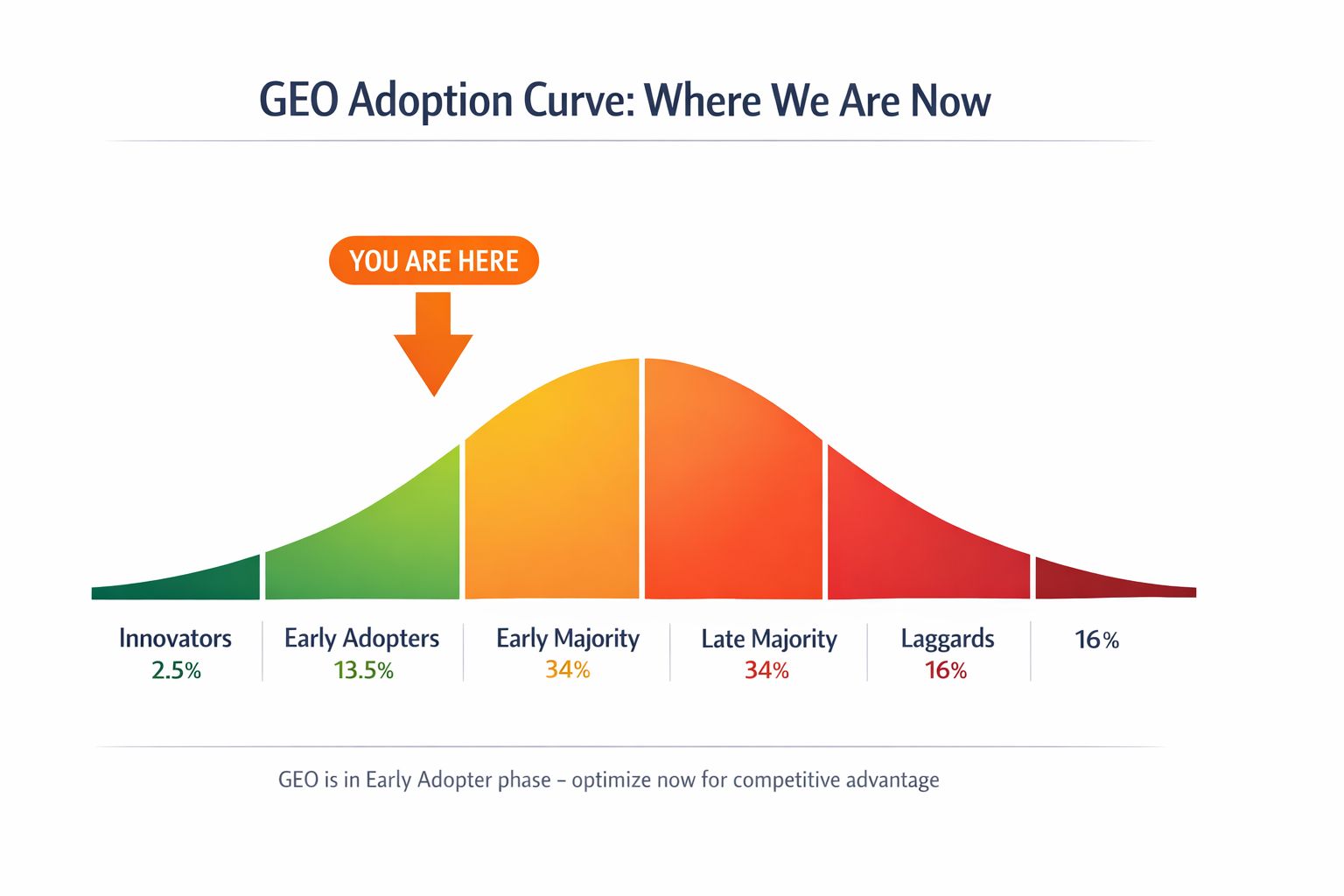
GEO is still in the Early Adopter phase. The opportunity window narrows as the market moves toward mass adoption.
The strategic question isn’t whether to invest in GEO—it’s how quickly you can implement it effectively while maintaining strong traditional SEO performance. Every month you wait, competitors gain ground in AI visibility that compounds over time as training data updates and recommendation patterns reinforce existing authority.
Your Next Move
Start with assessment: manually test your current AI visibility, audit your content for AI-friendliness, and identify your biggest gaps. Then prioritize the highest-impact implementations—typically FAQ content and structured data—that improve both AI and traditional search visibility simultaneously. Finally, commit to systematic optimization across platforms rather than sporadic efforts that fail to build momentum.
The search landscape transformed overnight when AI assistants reached mainstream adoption. The visibility strategies that protected your business for twenty years expanded to include new channels and new optimization approaches. Adapting quickly separates businesses that maintain market leadership from those that fade as user behavior shifts around them.
Your SEO expertise isn’t obsolete—it’s the foundation for the next phase of search visibility. The question is whether you’ll build on that foundation proactively or reactively.
Common Questions About GEO vs SEO
After helping businesses navigate the shift from traditional search to AI-powered visibility, these questions consistently surface. The answers reveal what actually matters when adapting your search strategy for the AI era.
Should I stop investing in SEO and focus entirely on GEO?
+No. This either/or thinking misses the strategic reality: successful businesses integrate both approaches rather than choosing between them. Google still processes over 8.5 billion searches daily, and traditional SEO continues driving measurable results. Abandoning SEO means losing visibility in a proven channel that still represents the majority of search behavior.
The most effective approach treats GEO as an expansion of your visibility strategy, not a replacement. Your SEO foundations—quality content, technical excellence, authoritative positioning—directly support GEO effectiveness. Build on what works while adding AI-specific optimization, creating comprehensive visibility across both traditional and AI-powered search channels.
How long does it take to see results from GEO optimization?
+GEO timelines vary significantly based on whether AI platforms already have your business in their training data and which platforms you’re targeting. For AI assistants with real-time web access like Perplexity, properly optimized content can appear in recommendations within 2-4 weeks. For training-based models like ChatGPT, you may wait several months until the next major data refresh incorporates your optimizations.
The unpredictability of these timelines argues for starting optimization now rather than waiting. Unlike SEO where you can accelerate results by building backlinks faster, GEO advantages compound as your information becomes embedded in training data cycles and recommendation patterns. Early movers establish positioning that becomes harder to displace as AI platforms mature.
Can I implement GEO myself, or do I need professional help?
+Basic GEO improvements—creating FAQ content, improving content clarity, and manually testing AI visibility—are absolutely achievable without professional support. Many businesses successfully implement these foundational optimizations using existing marketing resources. The challenge comes with technical implementations like schema markup, platform-specific optimization strategies, and systematic measurement approaches that require specialized expertise.
Professional guidance accelerates results by helping you prioritize high-impact changes, avoid common mistakes, and implement technical optimizations correctly the first time. What might take 6-12 months to figure out independently often gets implemented in 6-8 weeks with experienced support. The decision typically comes down to whether you have the time and technical capability to experiment and learn, or whether faster, more reliable implementation justifies the investment.
Which AI platform should I optimize for first?
+Start with the platform your target audience uses most frequently. For B2B professional services, that’s often ChatGPT or Claude given their adoption in business contexts. For research-intensive queries, Perplexity dominates because of its citation-focused approach. For general consumer queries, Google’s AI Mode and Bing’s Copilot matter most as they’re integrated directly into traditional search experiences.
The good news: many GEO optimizations benefit multiple platforms simultaneously. Clear content structure, proper schema markup, and FAQ-style information help your visibility across all AI assistants. Focus initial platform-specific efforts where your prospects concentrate, then expand to other platforms as you build experience and see results from your primary target.
What’s the biggest mistake businesses make when starting with GEO?
+The most common mistake is treating GEO like traditional SEO by focusing exclusively on keywords and technical optimization while ignoring content clarity and structure. AI assistants evaluate whether they can confidently cite your information, which requires clear explanations, direct answers to specific questions, and authoritative presentation—not just keyword optimization and backlinks.
The second major mistake is analysis paralysis: spending months researching and planning without implementing anything. GEO is still evolving rapidly, and the learning comes from systematic testing and refinement rather than perfect upfront planning. Start with foundational improvements (FAQ content, schema markup), measure results, then iterate based on what works in your specific situation rather than waiting for perfect knowledge before taking action.
How do I measure GEO success without traditional analytics?
+AI visibility tracking tools have emerged to fill this measurement gap. Major SEO platforms now offer dedicated features: Semrush’s AI Search Visibility, Ubersuggest’s AI Search Optimization, and Ahrefs’ Brand Radar all automatically query AI assistants with your target keywords and track whether your business appears in responses. These tools provide systematic tracking across platforms like ChatGPT, Perplexity, and Gemini, generating reports on citation frequency, competitor visibility, and brand mention trends.
However, measurement tools only reveal the problem—they don’t fix it. Knowing you’re invisible in ChatGPT responses doesn’t explain why or how to improve. That’s where strategic GEO implementation becomes essential: restructuring content for AI comprehension, implementing proper schema markup, creating FAQ-style information architecture, and platform-specific optimization. Professional GEO services combine measurement (tracking your visibility) with optimization (systematically improving it), ensuring you’re actively solving visibility gaps rather than just monitoring them.
Is GEO just a fad, or is this a permanent shift in search behavior?
+The shift toward AI-assisted search represents a fundamental change in how people access information, not a temporary trend. ChatGPT reached 100 million users faster than any consumer application in history. Gartner predicts traditional search engine volume will drop 25% by 2026 due to AI adoption. Google, Microsoft, and every major tech company are integrating AI directly into search experiences. These signals indicate permanent behavior change rather than temporary experimentation.
The relevant question isn’t whether GEO matters long-term—it’s whether you’ll adapt proactively while you have competitive advantage, or reactively once the market shift becomes undeniable and positioning opportunities have closed. History shows that businesses capturing early positions in new channels (mobile, social, voice search) maintain advantages competitors struggle to overcome later. GEO follows the same pattern.